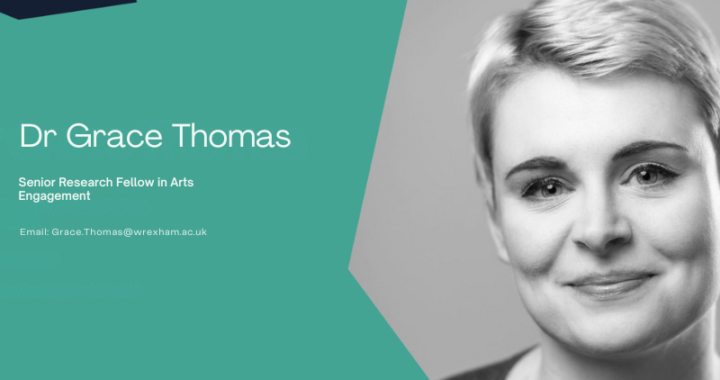
This is a guest blog in conversation with Dr Grace Thomas, Senior Research Fellow in Arts Engagement at Wrexham University. Accessibility and disability in the UK are still being misunderstood in 2026, despite increased awareness, policy discussions, and public conversation.
Accessibility and disability in the UK must be addressed with both urgency and empathy to bring about real change.
I met Dr Grace Thomas in December 2025 at the Catrin Finch Centre at Wrexham University, where she was delivering her talk Access All Areas. Disability and the Arts in Wrexham. It was the kind of talk that stays with you because it was grounded in reality, not theory.
When we spoke afterwards, we instantly found common ground. Grace approaches accessibility through research and community engagement. I approach it through lived experience as a disabled business owner. What connected us was a shared frustration that accessibility is still too often discussed without disabled people being properly involved.
In 2026, that needs to change.
Accessibility and Disability in the UK: Why Systems Still Fail.
The landscape of disability in the UK has shifted significantly. More people are now living with long term health conditions, many of them invisible, fluctuating, or progressive. Alongside this, an ageing population means more people are experiencing changes in mobility, stamina, cognition, and health in everyday life. This shift is essential to understand, especially in the context of Disability in UK.
This has brought disability into sharper focus. Not as a niche issue affecting a small group, but as something that touches far more people across different stages of life. For some, these barriers are new. For disabled people, they are familiar, particularly in relation to the ongoing discussion about Disability in UK.
What this shift highlights is an important truth. Disability is not always sudden or dramatic. It is often gradual, arriving through ageing, illness, injury, or cumulative strain. Systems that fail disabled people today are likely to fail many more people tomorrow.
Every conversation surrounding accessibility and disability in the UK must prioritise clarity and understanding.
That reality creates both urgency and opportunity. Urgency to address access gaps that have been tolerated for too long, and opportunity to build greater understanding, empathy, and shared responsibility.
As Grace explains, this shift has exposed realities disabled people have always known.
“Since the pandemic more people find themselves struggling with long term health conditions, notably invisible ones, and now face the barriers to support and understanding that many people faced before 2020.”
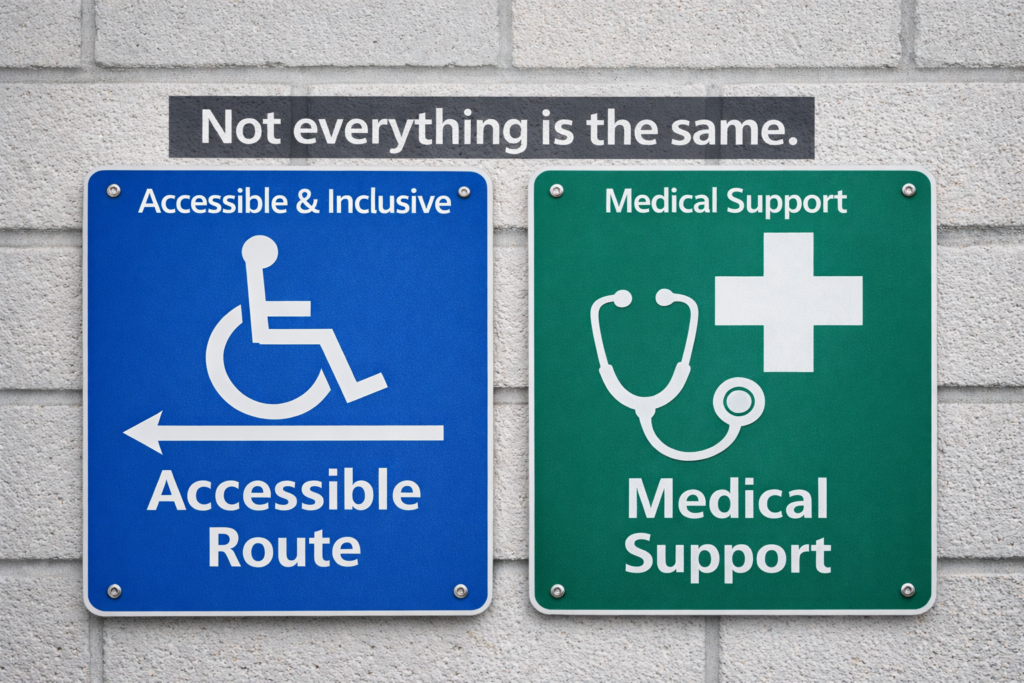
Clarity matters. Not everything is the same.
This is where precision becomes important.
Long term health conditions and disability can overlap, but they are not the same and should not be merged or blurred. Disability is not defined by diagnosis alone. It is defined by barriers. Physical barriers. Structural barriers. Systemic barriers. Accessibility exists to identify and remove those barriers so people can take part fully, consistently, and with dignity.
When these distinctions are blurred, accessibility conversations lose focus. Solutions become vague. Adjustments are watered down. Intentions may be good, but impact is lost. Clarity is not exclusion. It is what turns awareness into action and good intentions into real, usable access.
Inclusivity in accessibility and disability in the UK means recognising the diverse needs within the community.
Understanding has to work both ways
Accessibility works best when it is treated as a shared problem to solve, not a demand made on one side and resistance on the other. Disabled people need space to explain what creates a barrier for them, and organisations need space to explain what is possible, what is not, and why. Real progress happens when both sides are willing to listen, ask questions, and work together to find practical solutions that respect lived experience while navigating real world constraints.
That might mean acknowledging that a ramp is not currently possible at a main entrance, but exploring whether a side entrance can be adapted. It might mean rethinking how people are welcomed into a space, how routes are signposted, or how support is offered. Accessibility is not about perfection or instant fixes. It is about collaboration, honesty, and a genuine willingness to find workable solutions together.
The impact of rhetoric and fear
Alongside increased visibility, disability is also being discussed more harshly in political and media narratives. Disabled people are increasingly framed as a cost or a problem to be managed.
Ultimately, improving accessibility and disability in the UK is a shared responsibility.
Accessibility and disability in the UK must be at the forefront of our societal conversations.
Grace sees the consequences of this directly in her work with disabled communities.
“In forums I have held with disabled people, this causes a great deal of anxiety and uncertainty about the future.”
I see the same thing reflected in quieter ways. In messages that say, “I do not want to be a burden,” or “I am not sure I am allowed to ask for this.” This climate makes disabled people smaller, not more included.
That is not progress.
What we lose when disabled people are excluded
When disabled people are not meaningfully involved in decisions about access, everyone loses.
As Grace puts it:
“In failing to support and engage with those living with a disability, impairment or long term illness, we lose multiple benefits.”
Disability is not one experience. It intersects with gender, ethnicity, economic background, education, and geography. Two people with the same condition may have entirely different needs. When disabled voices are absent from policy making, project planning, event coordination, or building design, those differences are ignored.
The result is exclusion by default, even when intentions are good.
Optimism, realism, and lived expertise
I am known for advocating an optimistic approach to disability. That does not mean pretending barriers do not exist. It means recognising the strengths disabled people develop through necessity.
Grace captures this balance clearly.
“Having a disability can make you more compassionate and empathetic, but it can also make you more resilient and determined.”
That resilience is not abstract. It is practical knowledge built through lived experience.
“Disabled people can recognise and be proud of the unique knowledge we have through our lived experiences.”
When that knowledge is valued, decisions improve. Outcomes improve. Access improves.
Accessibility is not “almost”
One of the strongest areas of agreement between Grace and myself is around language.
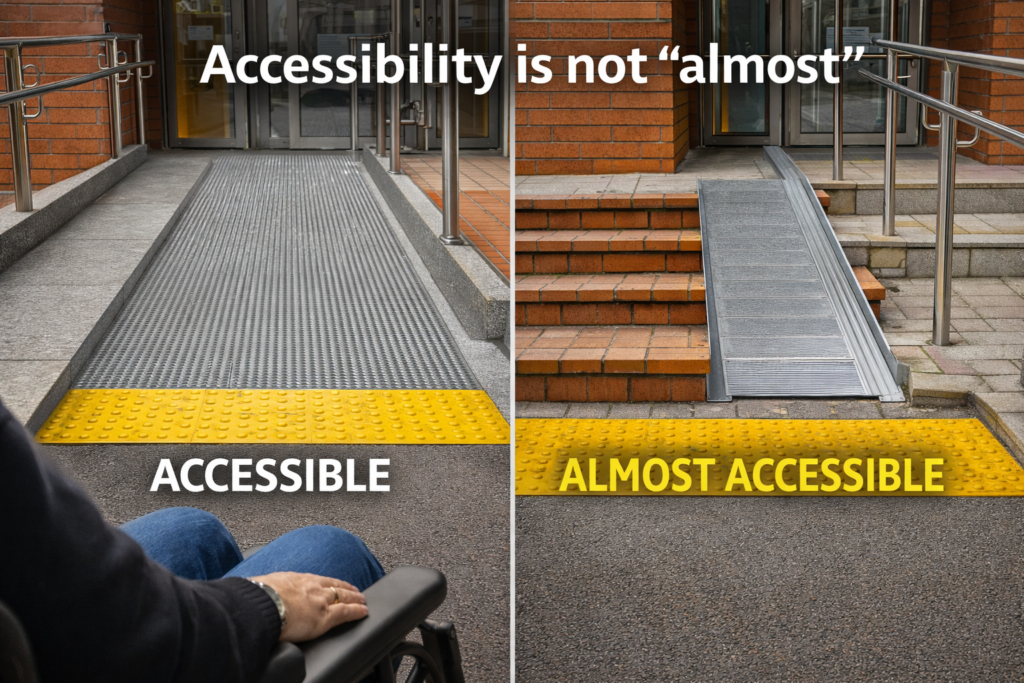
Accessibility is often described as partial, improving, or “as accessible as possible.” This framing softens failure and shifts responsibility away from organisations.
Grace is direct.
“Accessibility is not a scale but a clear binary. Something is either accessible and inclusive or it is not.”
There are genuine limitations for heritage buildings, small organisations, and outdoor events. No one expects a Grade 1 listed castle to be fully accessible. What disabled people do expect is honesty.
“We have to have honest conversations about accessibility and inclusion.”
Being asked is where it starts
Grace’s talk at Wrexham University left her feeling hopeful, despite the challenges of working in this space.
Disability and accessibility will continue to evolve. Language will change. Best practice will develop. Needs will differ.
But Grace’s closing point cuts through everything else.
“Everyone’s experiences and challenges are unique. The important thing is that we are asked.”
Ask disabled people.
Listen properly.
Include us from the start.
That is how accessibility begins.
A final word from Vicki
If this blog has made you pause, that is intentional.
Over the past year, I have been having quiet conversations with physically disabled entrepreneurs. Honest conversations about access, energy, boundaries, and what it really takes to run a business in a world that often assumes bodies, stamina, and systems all work the same way.
Those conversations have led to something taking shape.
It is not loud.
It is not performative.
And it is not for everyone.
If you are a physically disabled entrepreneur who believes accessibility should be practical, respectful, and built through conversation rather than confrontation, you may want to read this and decide for yourself:
https://mailchi.mp/8ce5c30818d8/if-you-are-a-physically-disabled-entrepreneur
There is very little detail, and that is deliberate.
No promises. No pressure. Just an invitation to be in the right room when the time comes.
You will know if it is meant for you.
Accessibility works when disabled people are part of the solution, not an afterthought.